New import duties prompt Indian mills’ price increases
India’s steel buyers have questioned whether the market can sustain increased costs after domestic producers raised their prices in response to the country’s reinstatement of 12% import tariffs on flat steel products.

The Indian government had allowed duties of up to 12% on a range of flat steel products to lapse, on November 7, following April’s 200-day application of the safeguard measure. In December’s Developing Markets Steel Review, MEPS reported that Indian steel prices were stable month-on-month, albeit hot rolled coil values were more than 11% down on their May peak.
Following the December 30 announcement of a new three-year import tariff regime, many steelmakers have increased their prices. MEPS respondents report prices up by INR2,000-5,000 per tonne (USD22-56) month-on-month. However, many say that buyers are unlikely to absorb such an uptick due to intense competition for sales.
Steel market analyst Kevin Wong said: “Indian steel buyers are now evaluating the new safeguard duty to determine which imports might remain competitive under the new measures, and which might be exempt. Imports from countries that have a free trade agreement (FTA) with India are exempt, for example, as are those destined for India’s export-oriented manufacturers.”
India’s new safeguard duties are designed to reduce the volume of low-cost steel imports into the country, particularly from China. Their implementation is backdated to April 2025, with a duty of 12% applied to imports until April 20 this year, falling to 11.5% for the 12-month period to April 20, 2027, and an 11% rate in the year to April 20, 2028.
Indian safeguard duties subject to exclusions
The safeguard measure excludes imports from certain developing countries and nations which have agreed an FTA with India. Neither will it apply to many speciality steel products, including stainless steel.
Imports which exceed a certain price threshold, on a CIF basis, will qualify for exemption. These thresholds are set at: USD675 per tonne for hot rolled coil, sheets and plates; USD824 per tonne for cold rolled coil and sheets; USD861 per tonne for metallic coated products; and USD964 per tonne for colour coated products.
Respondents to MEPS’s Developing Markets Steel Review report that steel prices remain under downward pressure, despite India’s growing economy and buoyant steel demand. India’s National Statistics Office estimates that the country will achieve GDP growth of over 7% in 2025, with growth above 6% forecast for this year.
India’s status as the world’s fastest growing major economy has made it a target market for overseas suppliers, particularly those in China. Nonetheless, India’s steel producers have continued to increase their output. This week, Tata Steel reported that its production had reached record levels in October-December 2025, rising by 12% year-on-year to 6.34 million tonnes. Meanwhile, provisional data published by the Steel Authority of India reported a record 2.1m tonnes in sales during December 2025 – up by 37% year-on-year.
The Indian safeguard measures’ influence on steel imports during the April-November period of 2025 suggests that these domestic producers will face reduced overseas competition in 2026. This will apply upward pressure to prices. Data from CEIC, a provider of global macroeconomic and industry statistics, shows that total steel imports declined by 36% year-on-year, to 4.19m tonnes, during the eight-month period.
Investigation into Indian steelmakers
India’s domestic steel producers will benefit from these improved trading conditions as the sector comes under scrutiny from an investigation into alleged price collusion.
Earlier this week, the Reuters news agency reported that 31 domestic producers have been subject to an ongoing investigation by the Competition Commission of India. It reported that the case was opened following a case brought before Tamil Nadu state court, in 2021, in which the Coimbatore Corporation Contractors Welfare Association alleged that nine steel companies had raised prices by 55% during a six-month period to March 11 that year.
Source:
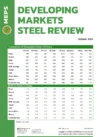
Developing Markets Steel Review
The MEPS Developing Markets Steel Review is an informative and concise monthly guide to carbon steel prices in important emerging markets around the world.
Go to productRequest a free publication